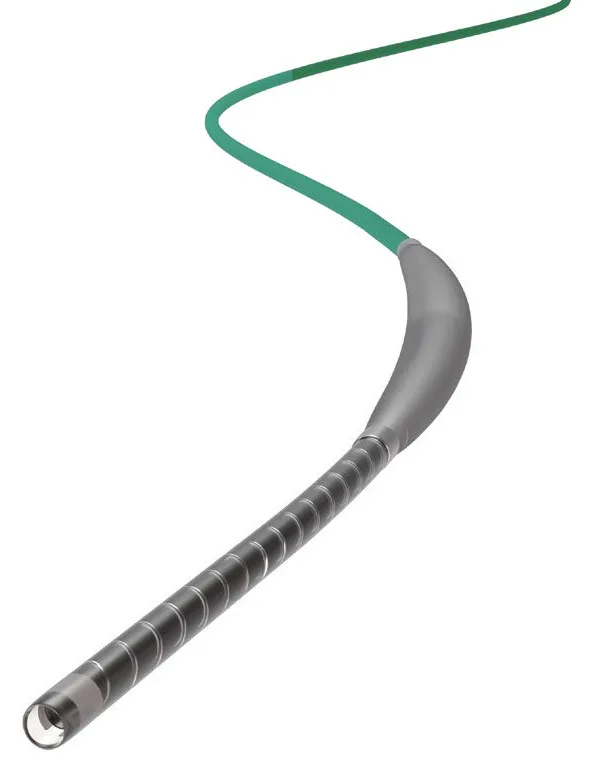
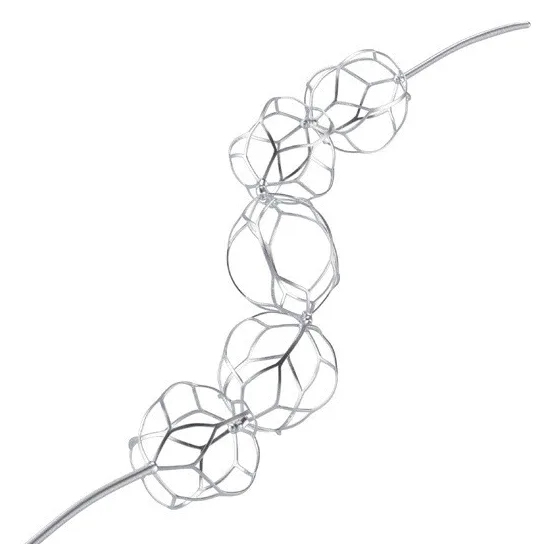
ERIC™Product Code (REF): ER176035
ERIC™ (Embolus Retriever with Interlinked Cages) is a stent-retriever style mechanical thrombectomy device for large-vessel occlusion acute ischemic stroke. Unlike conventional stent retrievers that use a single-layer mesh, ERIC is built from multiple interlinked spherical cages along its working length. This cage-in-series architecture creates a three-dimensional structure that captures thrombus of varying consistency — both soft, fresh clot and organized, harder thrombus — more reliably than a single-layer mesh that can slip around heterogeneous clot material. The device is delivered through a 0.017 in minimum catheter inner diameter (compatible with Headway 17) on a 203 cm pusher wire, making it compatible with the same access systems used for coiling and flow diversion. After deployment within the occluded vessel, the cages expand to appose the vessel wall and integrate with the thrombus. Combined aspiration via a SOFIA or SOFIA 88 catheter during retrieval (the SOLUMBRA technique) significantly increases first-pass recanalization rates. ERIC is available in 3.0 mm (15 and 20 mm working length), 4.0 mm (24 and 30 mm), and 6.0 mm (35 and 44 mm) sizes, covering the full range of large-vessel occlusion targets from distal M1 through ICA and basilar artery.
This page documents catalog code (REF) ER176035, one of 6 available configurations of the ERIC™. See the full ERIC™ overview for every configuration.
Available under product codes ER173015, ER173020, ER174024, ER174030, ER176035, ER176044.
Sizes & Specifications
- Device diameter
- 3.0 mm / 4.0 mm / 6.0 mm
- Working length
- 15 mm – 44 mm
- Microcatheter compatibility
- 0.017 in
- Pusher wire length
- 203 cm
Manufacturer: Terumo Neuro (MicroVention, Inc.) · Reference source: terumoneuro.com
Design & Technology
Technical characteristics and diagrams as published by Terumo Neuro (MicroVention).
ERIC™ Retrieval Device is reshaping ischemic stroke treatment by delivering thrombus control, procedure efficiency, and versatility approach when every second counts.
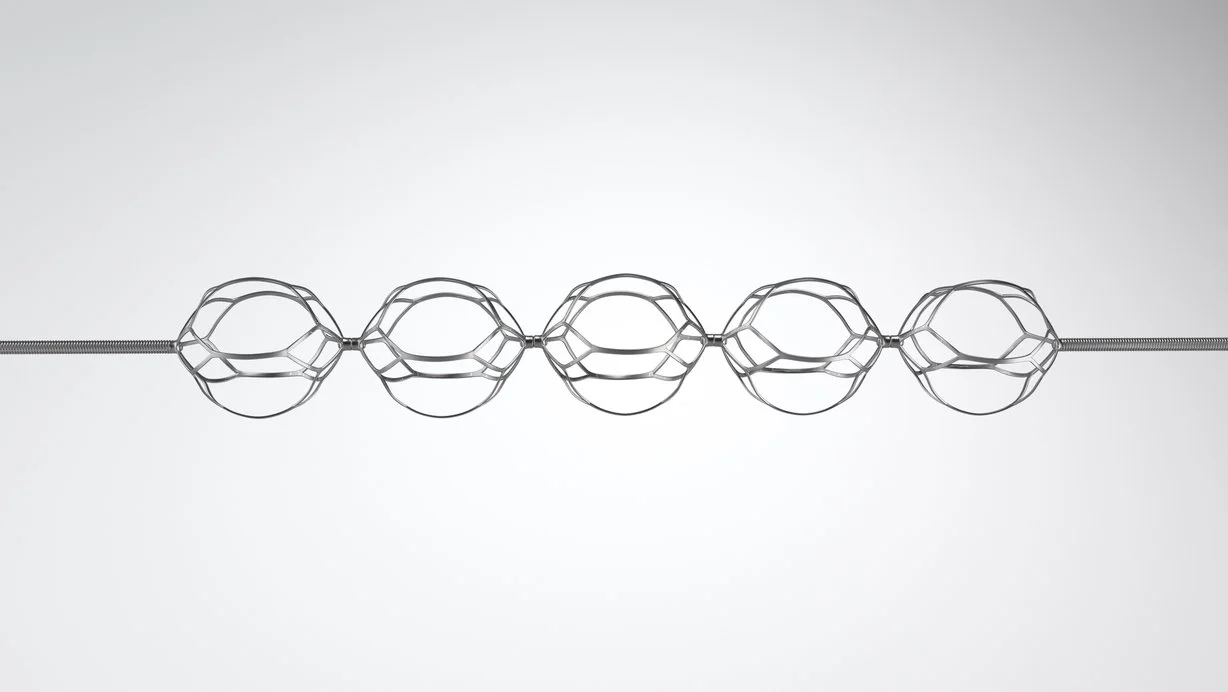
Thrombus Control
Uses radial force, integration zones, and cages to control clot inside and outside the device.
Procedure Efficiency
Designed to not require a clot integration wait time helping you support procedure efficiency.
Versatile Treatment Options
Comes in 6, 4, & 3 mm diameter sizes to give you the versatility needed to treat ischemic stroke.
Product Identification & Specifications
Reference identifiers for procurement, registration and tender documentation.
| Product Code | ER176035 |
|---|---|
| REF Numbers | ER173015, ER173020, ER174024, ER174030, ER176035, ER176044 |
| Manufacturer | Terumo Neuro (MicroVention, Inc.) |
| Brand | Terumo Neuro (MicroVention) |
| Product Family | Thrombectomy & Retrieval |
| Country Availability | Azerbaijan |
Clinical Applications
The ERIC™ is a thrombectomy device in the Thrombectomy & Retrieval family from Terumo Neuro (MicroVention, Inc.), used by interventional specialists in procedures where a thrombectomy device of this class is indicated. It is supplied in 6 configurations (catalog codes ER173015 through ER176044) to match anatomical and procedural requirements.
For the complete indications for use, contraindications and instructions for use (IFU), request the official Terumo Neuro (MicroVention) documentation through our clinical team. Azmed Devices supplies the ERIC™ to hospitals and clinics across Azerbaijan.
Ordering Information
Catalog reference codes as published by Terumo Neuro (MicroVention). Contact us to confirm current availability.
| Catalog # | Product Name | # of Spheres | Diameter (mm) | Working Length (mm) | Distal Tip Length (mm) | Min. Catheter ID (in) | Pusher Length (cm) |
|---|---|---|---|---|---|---|---|
| ER173015 | ERIC 3 | 3 | 3.0 | 15 | 5.0 | 0.017 | 203 |
| ER173020 | ERIC 3 | 4 | 3.0 | 20 | 5.0 | 0.017 | 203 |
| ER174024 | ERIC 4 | 4 | 4.0 | 24 | 5.0 | 0.017 | 203 |
| ER174030 | ERIC 4 | 5 | 4.0 | 30 | 5.0 | 0.017 | 203 |
| ER176035 | ERIC 6 | 4 | 6.0 | 35 | 5.0 | 0.017 | 203 |
| ER176044 | ERIC 6 | 5 | 6.0 | 44 | 5.0 | 0.017 | 203 |
Downloads & Documentation
Instructions for use (IFU), technical datasheets and clinical literature for the ERIC™ are available on request from our clinical team.
Request DocumentationFrequently Asked Questions
- What is ERIC™ and how does it work for stroke thrombectomy?
- ERIC™ (Embolus Retriever with Interlinked Cages) is a stent-retriever style mechanical thrombectomy device for large-vessel occlusion (LVO) acute ischemic stroke. Multiple interlinked spherical cages expand within the occluded vessel to engage thrombus of varying consistency. After deployment, the cages integrate with the clot and the device is retrieved — with or without concurrent aspiration via SOFIA or SOFIA 88 — to remove the thrombus and restore vessel patency.
- What sizes does ERIC™ come in?
- ERIC is available in three device diameters and six sizes: ERIC 3 (ER173015: 3.0 mm / 15 mm; ER173020: 3.0 mm / 20 mm), ERIC 4 (ER174024: 4.0 mm / 24 mm; ER174030: 4.0 mm / 30 mm), ERIC 6 (ER176035: 6.0 mm / 35 mm; ER176044: 6.0 mm / 44 mm). Device selection depends on the occluded vessel diameter: 3 mm for distal M1/M2; 4 mm for standard M1/ICA; 6 mm for large ICA or basilar artery.
- What microcatheter is used with ERIC™?
- ERIC requires a minimum catheter inner diameter of 0.017 in — compatible with Headway 17 Advanced. The pusher wire is 203 cm, allowing a 150–160 cm access system with sufficient length for manipulation. ERIC is deployed through the Headway 17 microcatheter that has been advanced past the occlusion over a 0.014 in guidewire.
- What is the SOLUMBRA technique and how is ERIC™ used in it?
- SOLUMBRA combines a stent retriever (ERIC) with simultaneous aspiration through a large-bore catheter (SOFIA 88 or SOFIA Plus). After ERIC deployment in the clot, continuous aspiration is maintained through the proximal aspiration catheter while the stent retriever is retrieved. This combined approach significantly increases first-pass recanalization rates and reduces the risk of distal embolization during clot retrieval compared to stent retriever alone.